Does the European Accessibility Act Apply to the UK?
The short answer is yes—for many UK organisations, the European Accessibility Act may still be relevant, even after Brexit.
At first glance, the answer appears straightforward.
The UK is no longer a member of the European Union, so it would be reasonable to assume that the European Accessibility Act does not apply to British businesses.
In reality, the position is more nuanced.
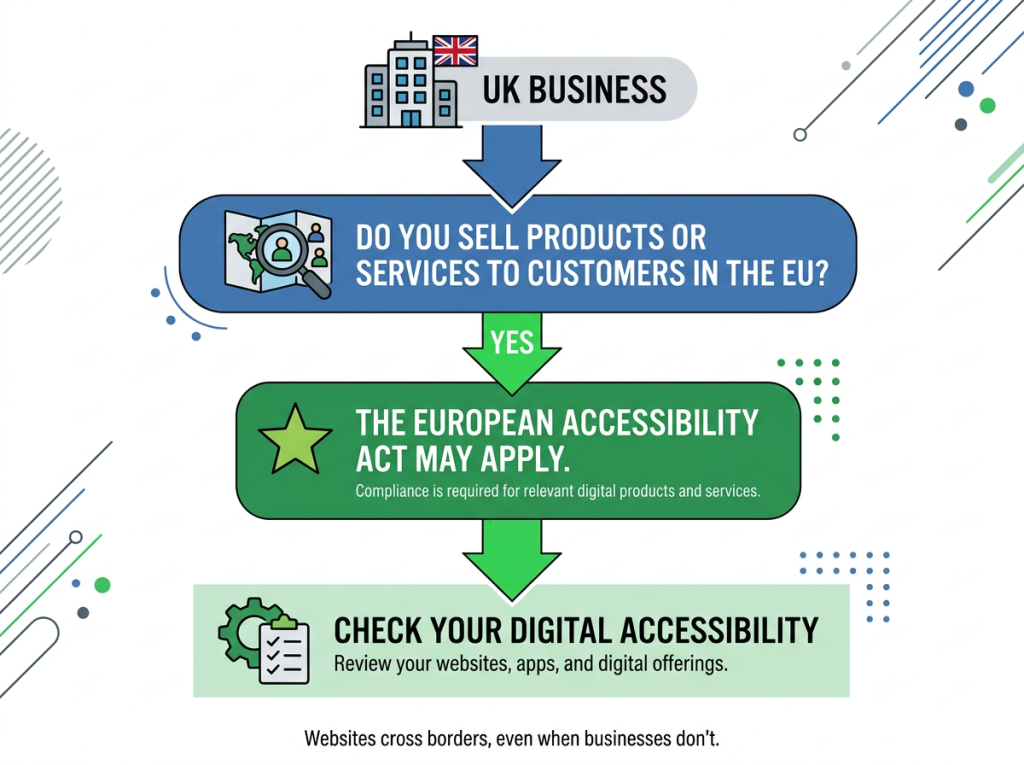
Many UK organisations provide products or services to customers within the EU. If they do, the accessibility requirements introduced by the legislation may still affect them. Just as the General Data Protection Regulation (GDPR) changed how organisations around the world approached personal data, accessibility legislation has the potential to influence businesses beyond the EU's borders.
Understanding when the legislation may apply is the first step towards reducing risk and ensuring digital products and services remain accessible to customers wherever they are located.
Book a free 15-minute consultation
Why UK Businesses Should Pay Attention
One of the easiest ways to understand accessibility is to think about a doorway.
Imagine a shop with a doorway that is too narrow for a wheelchair user. Once the doorway is widened, wheelchair users can enter—but so can parents with pushchairs, travellers with luggage, delivery drivers carrying parcels and anyone using walking aids.
The same principle applies online.
When websites, apps and digital services become more accessible, they become easier for everyone to use. Accessibility is not simply about meeting legal obligations; it is about removing unnecessary barriers for customers.
For UK businesses trading internationally, it is also becoming an important commercial consideration.
Brexit Does Not Stop Websites Crossing Borders
Brexit changed the UK's relationship with the European Union, but it did not change the nature of the internet.
A physical shop exists in one location. A website is available wherever someone has an internet connection.
That means a business based in Birmingham, Manchester or Edinburgh can still serve customers in Berlin, Paris or Madrid without opening an office overseas.
If your organisation supplies products or services into the EU, the accessibility requirements introduced by the legislation may still become relevant, regardless of where your business is headquartered.
This is one reason why many UK organisations are now reviewing their digital accessibility as part of their wider business strategy.
Your Website Is in Plain Sight
Unlike internal business systems, websites are public.
Customers, competitors, regulators and advocacy groups can all view the same website at any time.
That visibility means accessibility issues are often much easier to identify than many organisations realise.
While enforcement differs between Member States, inaccessible digital services are far more visible than many other forms of non-compliance. Businesses should therefore think proactively about accessibility rather than waiting until concerns are raised.
Which UK Organisations May Be Affected?
The legislation is not aimed at every UK business.
However, organisations are more likely to be affected if they:
- sell products to customers within the European Union
- provide digital services to EU consumers
- operate websites or mobile applications that support customers in EU countries
- work with organisations that expect accessible digital services as part of procurement requirements
Each organisation's circumstances are different, so understanding how products and services are delivered is an important part of determining whether accessibility obligations may apply.
Why Accessibility Makes Business Sense
Even where organisations conclude that the legislation does not directly apply, improving accessibility remains good business practice.
Accessible digital services are generally easier to use, reach a wider audience and provide a better experience for all users.
Accessibility can also improve usability, reduce customer frustration and support inclusive design principles that benefit every visitor.
Many organisations begin by commissioning an accessibility audit to understand where accessibility barriers exist before planning future improvements.
Similarly, following recognised standards such as WCAG 2.2 provides a structured framework for improving digital accessibility over time.
Frequently Asked Questions
Does the European Accessibility Act apply to every UK business?
No. Whether the legislation applies depends on factors such as the products or services provided and whether they are offered to customers within the European Union.
Does Brexit mean UK businesses can ignore the legislation?
Not necessarily. Businesses trading with EU customers may still need to consider the accessibility requirements introduced by the legislation.
Is this similar to GDPR?
There are similarities. Like GDPR, the legislation originated within the European Union but has implications for organisations outside the EU that provide products or services within the European market.
Should UK organisations improve accessibility even if the legislation does not apply?
Yes. Accessible digital services improve usability for everyone and can help organisations reach a wider audience while reducing barriers for disabled users.
Where should organisations begin?
The first step is understanding how accessible existing digital products and services are. From there, organisations can prioritise improvements and embed accessibility into future projects.
Consultation
If you're unsure whether the legislation applies to your organisation, book a free 15-minute chat with us. We'll help you understand your obligations and discuss practical next steps.
Final Thoughts
For many UK organisations, the key question is no longer whether accessibility matters but how it fits into their business.
Whether or not the legislation applies directly, accessible digital services are becoming an expected part of modern business. Organisations that understand this early are better placed to serve a wider audience, respond to changing expectations and build digital experiences that work for everyone.