EAA Accessibility: What It Means and Why It Matters
Understanding EAA Accessibility
EAA accessibility is becoming an increasingly important topic for organisations that design, develop or provide digital products and services. This guide explains what the term means, why it has become so widely used and how it relates to the European Accessibility Law, helping you understand why accessibility is now an essential part of delivering inclusive digital experiences.
Introduction
If you've recently searched for EAA accessibility, you're not alone. Since the introduction of the European Accessibility Act, businesses across Europe and beyond have been trying to understand what the term means and how it affects the way they design and deliver products and services.
Although EAA accessibility 2025 became a popular search phrase around the time the legislation came into force, accessibility is not simply a one-off legal deadline. It represents an ongoing commitment to creating products and services that can be used by as many people as possible, including disabled people and those with access needs.
While the legislation provides the legal framework, EAA accessibility is the practical application of those principles. It covers the way organisations design, develop, test and continually improve their digital products and services to ensure they remain accessible throughout their lifecycle.
If you're unfamiliar with the legislation itself, our guide to the European Accessibility Act provides a complete overview of the law.
Our guide explaining the EU Accessibility Act explores why the legislation is often referred to by that name.
Whether you're planning a new digital service, reviewing an existing website or simply trying to understand your responsibilities, understanding EAA accessibility is an excellent place to start.
Book a free 15-minute consultation
What Does EAA Accessibility Mean?
The term EAA accessibility describes the practical process of ensuring that products and services meet the accessibility requirements introduced by the European Accessibility Act. Rather than referring to a single technical standard or software product, it encompasses the way organisations design, develop, test and maintain accessible experiences for everyone.
Accessibility is about removing barriers that might prevent disabled people from using a product or service independently. This could include making websites easier to navigate with a keyboard, ensuring mobile applications work with screen readers, providing sufficient colour contrast, or making online forms simpler to understand and complete.
The concept extends far beyond websites. Depending on the products or services being offered, EAA accessibility may also involve mobile applications, e-commerce platforms, banking services, ticketing systems, self-service terminals, e-books and other digital technologies that people rely on every day.
For many organisations, accessibility is no longer something that can be added at the end of a project. It is most effective when considered from the very beginning, influencing design decisions, development practices, testing and ongoing improvements throughout the product lifecycle.
This is why accessibility is increasingly viewed as a continuous process rather than a one-off exercise. Organisations that build accessibility into their everyday workflows are often able to deliver better user experiences while reducing the cost and complexity of fixing problems later.
If you're planning a new digital service, following the principles of accessible web design from the outset is usually far more effective than attempting to retrofit accessibility after launch.
Why EAA Accessibility Has Become Such an Important Topic
Although EAA accessibility 2025 became a widely searched phrase around the time the legislation came into force, the interest in accessibility has continued to grow. Many organisations first became aware of their responsibilities during 2025, but the need to create accessible products and services did not end once the implementation date had passed.
Today, accessibility is increasingly recognised as an essential part of delivering high-quality digital experiences. Organisations are expected to consider accessibility throughout the lifecycle of their products and services, from the earliest planning stages through to development, testing and ongoing maintenance.
There are several reasons why EAA accessibility has become such an important topic.
Firstly, millions of people rely on accessible products and services every day. Whether someone uses a screen reader, voice recognition software, keyboard navigation or simply benefits from clear and consistent design, accessibility helps ensure that digital services can be used independently and confidently.
Secondly, organisations are recognising that accessibility is good business. Accessible products often provide a better experience for everyone, improve customer satisfaction and reduce barriers that might otherwise prevent people from completing tasks online.
Finally, accessibility should be viewed as an ongoing commitment rather than a one-off project. New features are added, websites evolve, mobile applications are updated and customer expectations continue to change. Accessibility therefore needs to be maintained over time rather than treated as a single compliance exercise.
Many organisations use WCAG 2.2 as the recognised technical standard for designing, developing and testing accessible digital services. While legislation sets out the legal requirements, the standard provides practical guidance on how many accessibility barriers can be identified and addressed.
What Does Accessibility Cover?
Accessibility is often associated with websites, but EAA accessibility extends much further than a single webpage or online service. The legislation applies to a wide range of products and services that people use every day, placing accessibility at the heart of the customer experience.
Depending on your organisation, accessibility may include:
- Websites and online portals
- Mobile applications
- E-commerce platforms
- Banking and financial services
- Transport booking and ticketing systems
- E-books and digital publications
- Self-service kiosks and payment terminals
- Customer communication and support services
Although every organisation is different, the principle remains the same. Products and services should be designed so that they can be used by as many people as possible, regardless of disability or the technology they rely upon.
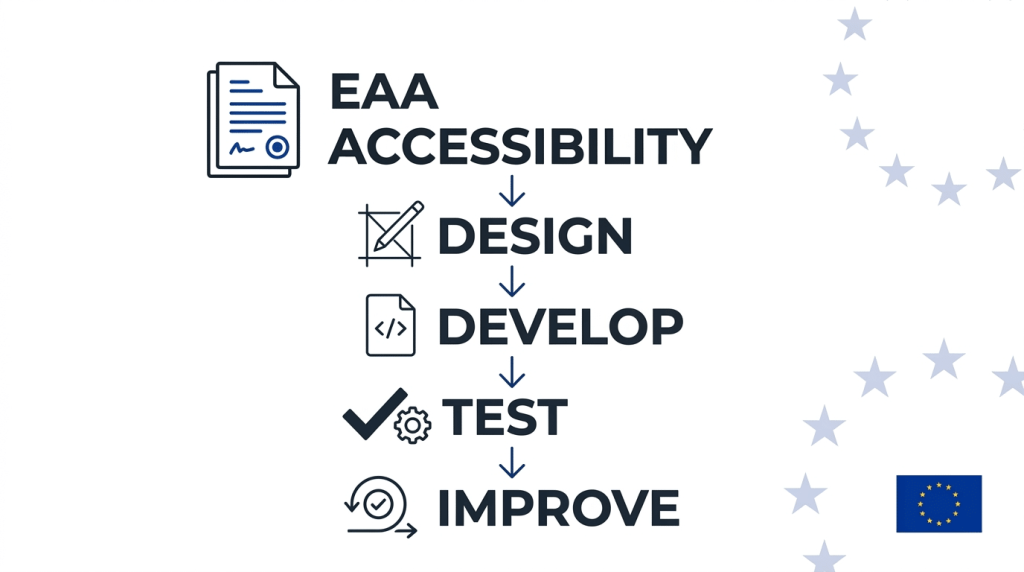
Accessibility is not achieved by a single activity. Instead, it should be considered throughout the entire lifecycle of a product or service.
Figure 1 illustrates this continuous process.
Insert infographic here
Figure 1. Accessibility should be considered throughout the lifecycle of a product or service, from initial design through to continuous improvement.
Rather than treating accessibility as a final check before launch, successful organisations build it into every stage of a project. This typically begins with accessible design, continues through development, is verified through testing and remains an ongoing process as products and services evolve.
Where existing websites or applications are already in use, carrying out an accessibility audit is often the most effective way to understand current accessibility barriers and prioritise future improvements.
Who Should Be Thinking About EAA Accessibility?
Although the legislation applies to specific products and services, EAA accessibility is relevant to a much wider audience than many organisations initially realise.
If your organisation designs, develops, manages or supplies digital products or services, accessibility should already be part of your planning process. Whether you're launching a new website, updating a mobile application or improving an existing online service, considering accessibility from the outset is far more effective than making changes after launch.
EAA accessibility is particularly important for:
- Business owners planning new digital services.
- Website owners reviewing existing platforms.
- Designers creating user interfaces and customer journeys.
- Developers building websites, software and mobile applications.
- Product managers responsible for digital services.
- Marketing teams publishing online content.
- Procurement teams selecting third-party platforms or software.
Even organisations that are not directly affected by the legislation often choose to improve accessibility because it leads to better user experiences, broader customer reach and more inclusive digital services.
Rather than viewing accessibility as a legal obligation alone, many organisations now see it as part of delivering quality. Digital services that are easier to understand, navigate and use tend to benefit everyone, not just disabled users.
For many organisations, the most successful accessibility programmes begin with awareness. Once accessibility becomes part of everyday decision-making, it naturally influences design, development, content creation, testing and future improvements.
Common Misunderstandings About EAA Accessibility
As awareness of accessibility has grown, so too have the number of misconceptions surrounding what it involves. Understanding the facts can help organisations make better decisions and avoid unnecessary confusion.
"Accessibility only affects disabled people."
This is one of the most common misconceptions. While accessibility is essential for many disabled people, improvements such as clearer navigation, better colour contrast, simpler language and more consistent layouts often benefit everyone, including older users, people using mobile devices and those in challenging environments.
"Accessibility is just about websites."
Websites are only one part of the picture. Depending on the products and services an organisation provides, accessibility may also include mobile applications, self-service terminals, digital documents, customer communications and many other technologies.
"Accessibility can be added just before launch."
Accessibility is most successful when it is considered throughout a project. Designing with accessibility in mind from the beginning is usually more effective and considerably less expensive than correcting problems after a product or service has been released.
"Accessibility is a one-off project."
Accessibility is not something that can simply be completed and forgotten. Websites change, software is updated, new content is published and customer expectations continue to evolve. Maintaining accessibility requires ongoing attention as products and services develop over time.
"Automated tools can check everything."
Automated testing tools are extremely valuable, but they cannot identify every accessibility issue. Many barriers can only be found through manual testing and by involving people who use assistive technologies such as screen readers, voice recognition software and keyboard navigation.
Book a free 15-minute consultation
Frequently Asked Questions
What does EAA stand for?
EAA stands for the European Accessibility Act. The abbreviation is widely used by organisations, consultants and technology providers when discussing accessibility requirements introduced by the legislation.
Is EAA accessibility only about websites?
No. While websites are an important part of accessibility, EAA accessibility also applies to many other products and services, including mobile applications, e-commerce platforms, banking services, transport booking systems, self-service terminals and digital publications.
Why has EAA accessibility become so important?
Awareness of accessibility has increased significantly since the legislation became applicable in June 2025. Organisations are increasingly recognising that accessible products and services provide better experiences for everyone while helping meet legal obligations where applicable.
Is accessibility a one-off project?
No. Accessibility should be viewed as an ongoing process. As products, services and technologies evolve, accessibility should continue to be reviewed, tested and improved to ensure barriers do not develop over time.
Does EAA accessibility mean my organisation must comply with the legislation?
That depends on the products or services your organisation provides and where they are offered. Understanding whether the legislation applies to your organisation requires consideration of your specific circumstances, which we explore in our other guides.
Where Next?
Continue your reading:
- Complete guide to the legislation
- Why it is often called the EU Act
- What is EAA? (Coming soon)
- EAA Compliance (Coming soon)
Book a free 15-minute consultation
Final Thoughts
EAA accessibility is about far more than meeting legal requirements. It represents a practical approach to designing, developing, testing and continually improving products and services so they can be used by as many people as possible.
As organisations continue to improve their digital services, accessibility should be viewed as an ongoing commitment rather than a single project. Building accessibility into everyday processes not only benefits disabled users but also creates better experiences for customers, employees and the wider public.
Whether you're just beginning your accessibility journey or looking to strengthen existing practices, taking a structured approach today will help create more inclusive and sustainable digital experiences for the future.